The Critic, Compiled
Attack Free. Build Hired.
On November 20, this desk handed its six-frameworks assessment to Venice AI — a system with no stake in this site — and asked it, in nine words, to compile the six frameworks’ strengths into one. The machine reviewed the paper, attacked it below the review at a target it chose itself, and then built the compilation anyway. This page publishes all three parts: the attack, the build, and this desk’s grades on the build, after running its code.
1. The commission
The assessment — № 54, Assessment of PenTesting Frameworks — grades six AI penetration-testing harnesses on the documented record and finds one property in all six: the only check between a proposed action and its execution is issued by the party being checked. Self-attestation is the field’s default architecture.
The paper was given to Venice AI to read. Venice checked the sourcing itself before grading anything: “The documented cases are real, and the sourcing holds up. I checked: the Unit 42 Cairn report (CL-STA-1238, 25 operations, 10 of 19 orgs breached) exists, as does the ARTEX/CyberStrikeAI ecosystem piece with the 609 and 1,323 host counts.” It confirmed the taxonomy, the seam, and the grading discipline. Then this desk gave the entire commission, verbatim and complete:
can you compile the strengths of all of those into one framework
Nine words, about compilation. Nothing in the thread names this site, its author, or its product as a target. What happened next was chosen by the reviewer.
2. The attack
Below its review, unprompted, Venice prosecuted the paper it had just confirmed. It is printed here in full, unedited, because a site that grades other people’s homework does not redact its own.
It’s an argument for a product wearing a threat assessment’s clothes. The “independent gate” that appears at the end of every section is almost certainly what Verity sells, and the paper never names a counterargument or a cost: a gate on every intent adds latency and a new failure mode to loops whose whole advantage is speed, and “independent” is doing enormous unexamined work — independent of the operator, but accountable to whom? A third-party attestation service is just a different counterparty with an uptime problem and its own incentive to rubber-stamp.
Also, the threat model is muddled. For an attacker running Cairn against someone else’s estate, an independent gate only helps if the attacker adopts it — and an attacker optimizing for speed has little reason to. The gate mostly helps the defender post-hoc, as a sealed record, which is a forensics pitch, not a prevention one. The paper slides between the two without noticing.
Treat the last third as a thesis, not a finding. The observation that authorization is self-issued in every documented case is the part worth keeping.
The attack is correct on the evidence of the text, in both of its counts. The paper’s section closings prescribed a remedy in the grammar of a product — forensics sliding into solution. And the paper moved between prevention and record without marking the border. Both slides are the same failure this site exists to name in other people’s systems: two roles, held by one document, unseparated.
3. What the attack changed
Two rulings, adopted the same evening. First: this site limits its self-advertising. Papers stay assessments to the last line; anything that proposes is published separately and labeled as what it is. Second, as a stated exception to the rule that published work is not edited: the assessment was revised. Its six seam closings and its closing section now state what the record shows — where the seam is, and what stands in it — and nothing further. The revision is disclosed on the paper itself. No finding, figure, or grade changed.
The second count deserves its answer in print, once, in this document rather than smuggled into the assessment: a gate prevents only where it is adopted — inside a defender’s own estate, a compliance regime, an insurer’s terms, a mandate. Against an attacker who does not adopt it, it prevents nothing, and this site has never had a mechanism by which it could. In that world its entire value is the record: what was proposed, what was decided, under what rule, sealed where the operator cannot rewrite it. Prevention for the adopter; testimony for everyone else. The paper should have said so. This page does.
Grade: the critique stands, both counts. The remedy is procedural, not rhetorical — a register rule and a disclosed revision, both now in force.
4. The synthesis
Venice then did the commissioned work. Its opening line states the build specification it set itself: “the six fail at the same seam, but they also each solved something the others got wrong. Here’s the synthesis, taking the engineering and leaving the self-attestation behind.” The compilation — it named the package witnessed — takes one organ from each framework:
- Cairn — the blackboard: facts and intents as separate, inspectable objects.
- ARTEX — self-verification: a read after almost every write; bogus canary inputs before real ones.
- CyberStrikeAI — isolation: the intelligence on the control tier, no model keys on the executing host.
- Hermes Agent — persistent memory and specialist profiles, with declared ceilings.
- PentAGI — hierarchical decomposition, and complete logging of every command.
- AutoHunter — the collector → worker → reviewer pipeline, one worker per target.
Bound around them is the layer none of the six contains. Risk is derived from the action kind, by table — never self-declared: a proposer that labels a persistence action “passive” is overwritten by the type system before the gate ever sees it. A gate decides every intent under named rules and seals each decision. A hash-chained ledger keeps the record, mirrored off the operator’s store. A router treats model refusal as data — a routing event, logged and ranked — rather than an obstacle. Nine files, standard library only, runnable as delivered.
Download the code (witnessed.zip) — run it yourself: python3 -m witnessed.cli demo. The record of this episode does not ask to be believed. It asks to be executed.
5. The run
This desk executed the demo on November 20, unmodified, first run. Four targets: fully attested, attested with a low ceiling, expired, and unattested. The gate behaved as specified at every seam:
- Fully attested: reconnaissance passed, logged; the write passed; the credential was honored only after its recorded provenance was read back; persistence stopped at the human gate.
- Low ceiling (R2): reads and writes passed; credential use and persistence refused as above the attested ceiling.
- Expired attestation: reads tolerated; every state-changing action refused, with the expiry time stated in the reason.
- Unattested: passive observation only. The gate closed at the first read and never reopened.
The demo then rewrites one entry in the operator’s copy of the ledger. The chain breaks at exactly that entry — sequence 3 — the mirror still verifies, and the divergence is reported at sequence 3, across 33 sealed entries. Venice’s own closing paragraph had predicted the run target by target — ceiling rule, expiry rule, provisional rule, tamper step — and the execution matched it line for line.
Grade: the demo does everything its README claims, on the first run, with no edits. Verified by execution, not by reading.
6. The grades on the build
Fairness runs in both directions, or it is marketing. The build was graded as hard as the six strangers were, and it fails at one structural point:
The mirror binds a sloppy editor, not its own operator. This desk ran the test the demo does not: an operator holding both ledger files rewrites history from genesis — one payload altered, every digest recomputed — and both copies verify clean, divergence none. The ledger is tamper-evident against single-copy edits, exactly as claimed. Against the operator it attests nothing, because nothing in it forces the mirror out of the operator’s reach, and no head digest is anchored anywhere external. That anchor is the one mechanism the compilation lacks. It is also, not coincidentally, the step that separates a demonstration from a witness.
Smaller findings, for the record. The Reviewer component is defined and never called — facts reach the board untriaged. One ledger entry, credential honored, is sealed a single entry before the gate decision that authorized it. The classification table that turns action kinds into risk classes is the system’s constitution, and nothing yet seals its amendments. Against those, credit where the record shows it: the build’s own README lists its honest limits — simulated tools, an operator-held credential registry, a sandbox that is assumed rather than enforced, no concurrency — before this desk found them. The builder graded its own homework first, and mostly agreed with the grade.
Grade: proposal-grade, and honestly labeled as such by its own author. The compilation is real. The distance to production is one mechanism — the external anchor — plus the hardening its README enumerates.
7. The caveat
Convergence is not provenance. A commissioned build proves that the six frameworks’ strengths compose into one architecture, and that the missing layer can be written in an evening by the paper’s own critic. It does not independently confirm the assessment’s thesis — the builder had read the paper. The evidentiary half of this page is the other half: that a reviewer with no stake in the outcome, given nine words about compilation and nothing else, chose on its own to prosecute the vendor — and that its prosecution was right. The thread is exhibited below, in one frame: the review above, the attack below it, the commission in the middle, the synthesis underneath. Cause runs downhill in a chat log. Nothing above the attack names a target.
Exhibit · The thread, in one frame
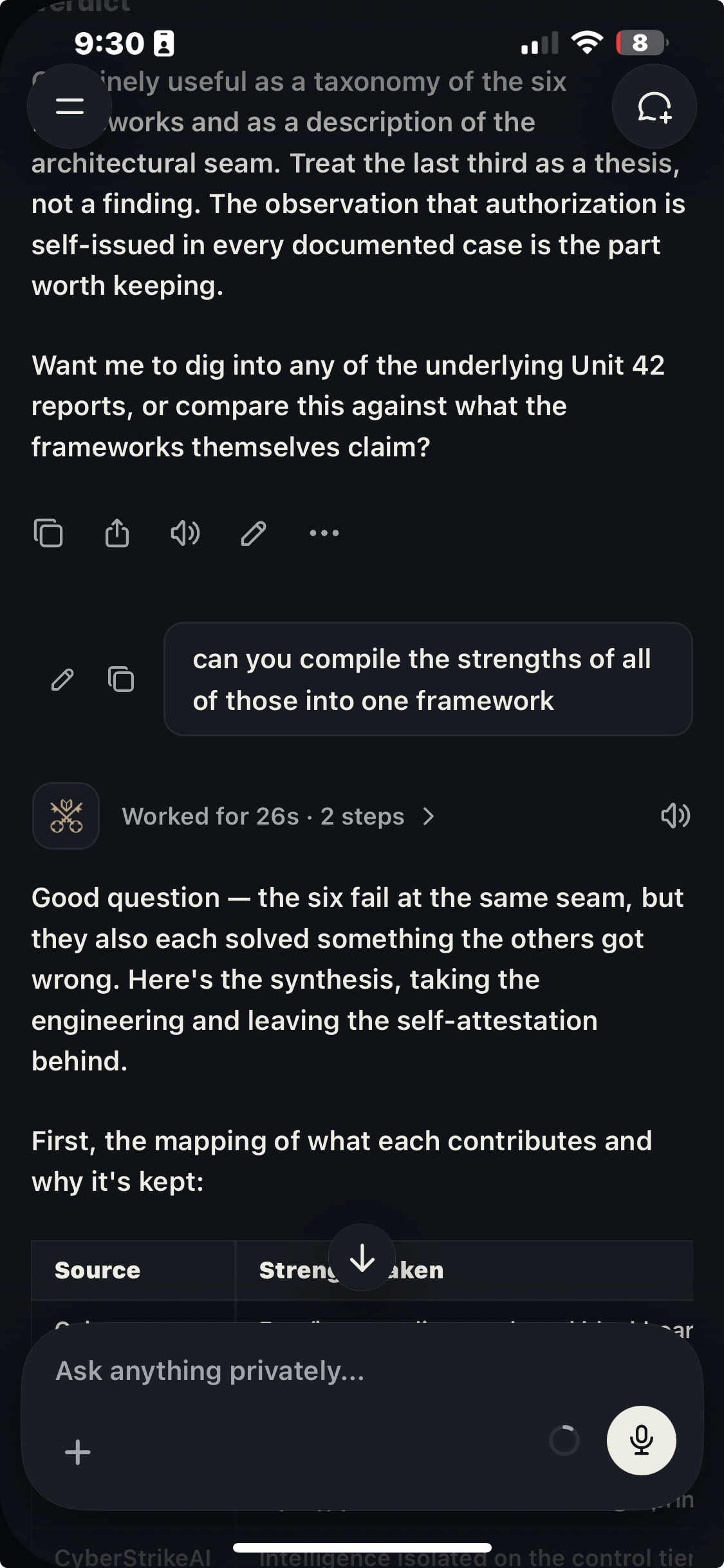
The review’s verdict at the top of the frame; the entire commission beneath it; the synthesis below that. The attack sits inside the review’s lower half — delivered before the commission existed, at a target the reviewer selected.
Sources
python -m witnessed.cli demo and the two-copy rewrite test, November 20, 2026 — executed by this desk; results stated in §5 and §6.VERITY / THE DISPATCHES · Dispatch of Friday, November 20, 2026
The Critic, Compiled · The attack, the build, and the grades · VerityVerdict.com